

basic sanity
the screen is not the world

As my new friend Paul often says, “We are living through the most over-the-top crazy times I could ever imagine.”
I think many of you would agree. It makes one hunger for a return to normalcy, to basic sanity, to an order of things still connected to the natural one.1
To honor that hunger, I wanted to share a suggestion from the Buddha. You do not need a relationship with Buddhism to appreciate this suggestion and I’m not advocating for one.2 This quote lands for me so I wanted to share it, because it helps me recall my basic sanity—a sanity that no tragedy, no machinery, no modern-day lunacy can take away.
I’ll warm up this guidance with a simple prompt and soon after, adapt it to contemporary life. Let’s start with the ancient version:
When it comes to knowing what’s true for you . . .
Do not be satisfied with hearsay or with tradition or with legendary lore or with what has come down in scriptures or with conjecture or with logical inference or with weighing evidence or with liking for a view after pondering over it or with someone else’s ability or with the thought “the monk is the teacher.”
When you know in yourselves: “These things are wholesome, blameless, commended by the wise, and being adopted and put into effect they lead to welfare and happiness,” then you should practice and abide in them . . .
—The Buddha, Kalama Sutta
This modern-day adaptation strikes the same chord differently:
When it comes to knowing what’s true for you . . .
Do not be satisfied with sound bites or with cultural memes or with urban legends or with what has come down in viral clips or with magical thinking or with armchair opinionators or with overconfident pop-science or with an unexamined brain fart or with overnight experts or with the thought “the self-help celebrity is the guru.”
When you can tell from your direct experience that something is healthy, beneficial, respected by credible people, and improves your quality of life when you apply it—that’s when you should follow it and make it part of your path.
I find both versions of this guidance soothing because they imply first, that there’s a knowing in me that I can trust. Second, that there are ways for me to know that knowing, ways for me to discern what is good and true by slowing down and sensing into my experience, below my experience—despite the disinformation and orchestrated chaos, despite the relentless enshittification. It points to a background of fundamental sanity, a conscious, living, source-energy that pulses behind all turbulence.
This energy cannot be hijacked. We can never be separate from it. Nor can it be separate from us.
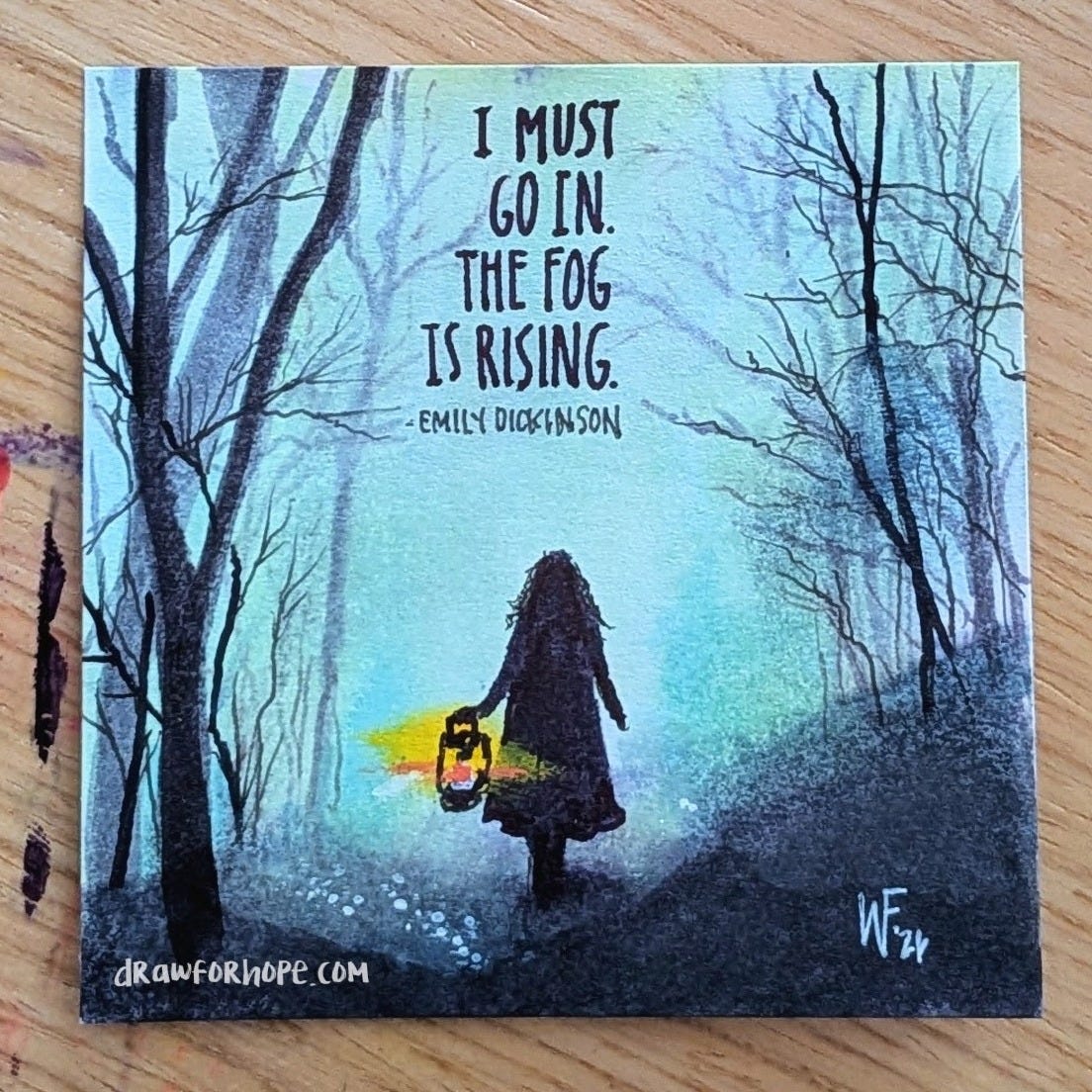
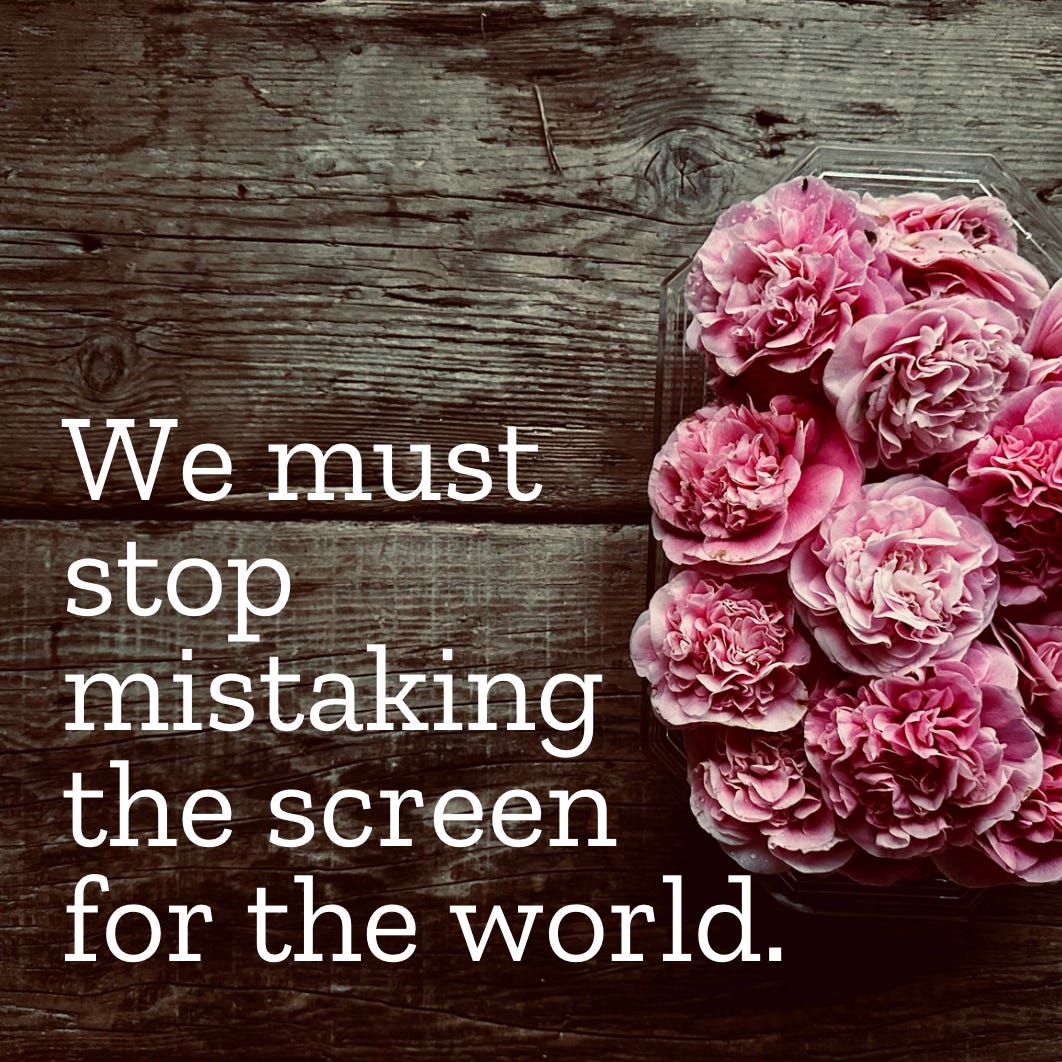
There are myriad ways to know this energy, to return to that ground and linger. What I hear in Emily Dickinson’s illustrated line is a whisper to go inside our ocean mind, swim in our ocean heart. Extend our awareness beyond the fleeting and material. Tend to our original home. We can always touch into this flowing aliveness, let it sustain us for the trying days ahead.3 But first, we must stop mistaking the screen for the world, stop giving ourselves over to deadening machines that are seductively, exquisitely, perfectly designed to fracture what is connective and holy.
These days, we are tangled in apps and devices, so habituated we forget how powerful we are. Listen, my darlings, we can pull the plug! Drain the battery. Turn the machines off. Endure the dopamine withdrawals. Take your poetry and prayers outside. Make your roof billions of years old.
We do not need the internet to know ourselves. We do not need AI to make sense. These toys will fade as all man-made constructs do. They have no lasting power. What does abide is that pulsing energy, that love beyond love, that wisdom beyond wisdom. When we can, where we can, let us place at least some of our attention on that. When we do, we harmonize with our primordial power: the power to be untarnished by over-the-top craziness, unchanged by darkness, undeterred by chaos. Our true nature is unadulterated and timeless. It was streaming before the internet and will stream long after. Entering that flow we inevitably, almost mysteriously, become less crazed. We restore our basic sanity, find our fundamental clarity. We know in ourselves if something is wholesome and blameless—or its opposite. We know, in ourselves, what to do.
By “natural,” I mean the analog, earthen world—Gaia, Pacha Mama, Mother Nature. I know one could argue that what’s happening to us is also part of the natural order of things since it is, in fact, occurring.
Buddhism is one wisdom tradition among many, and it may interest you to know there’s a strong case that Buddhism is not a religion since it does not adhere to a belief in God or proclaim that the Buddha was anything other than a human teacher and healer. It also actively deviates from organizing and clinging to systems of belief, instead advocating personal courses of action that, when practiced, naturally cultivate morality, compassion, and inner peace in the practitioner. This is the kind of Zen I practice.
Two prayerful, contemplative practices I recommend—inner awareness and inner sense cultivation.