

the thread
find one thing that does not change

In a biography on Zen monk Shunryu Suzuki,1 a student somewhat cheekily asks him to summarize the essence of Zen in one statement. Startlingly, the monk does.
He says, “Everything changes.”2
This statement is significant in the swiftness of its truth and in Zen, we lean into the direct experience of that truth. Zen students are strange people who do strange things—things counter to a reductionist culture, things human minds and bodies evolved to avoid—things like embracing uncertainty, touching into not-knowing, sitting with groundlessness, and welcoming change. Zen students practice coming alongside these inconvenient and uncomfortable things because doing so is challenging and gorgeous. It makes us braver, more sane, by moving us closer to what is real.
I respect any effort to face the sometimes hard truths of life and I encourage people, including myself, to turn toward them, to not look away. At the same time, I am human, so I know that groundlessness and instability—particularly when it’s relentless—is hard on the body. Hard on the nervous system. Hard on the heart and mind. There are better and worse ways we can meet uncertainty; it’s true.
Still, we are mammals, and mammals crave things we can count on.
Yesterday, I remembered a poem by William Stafford called The Way It Is. In it, he writes about a thread we follow, one that does not change. You will find the poem below. Please take a moment to read his words.
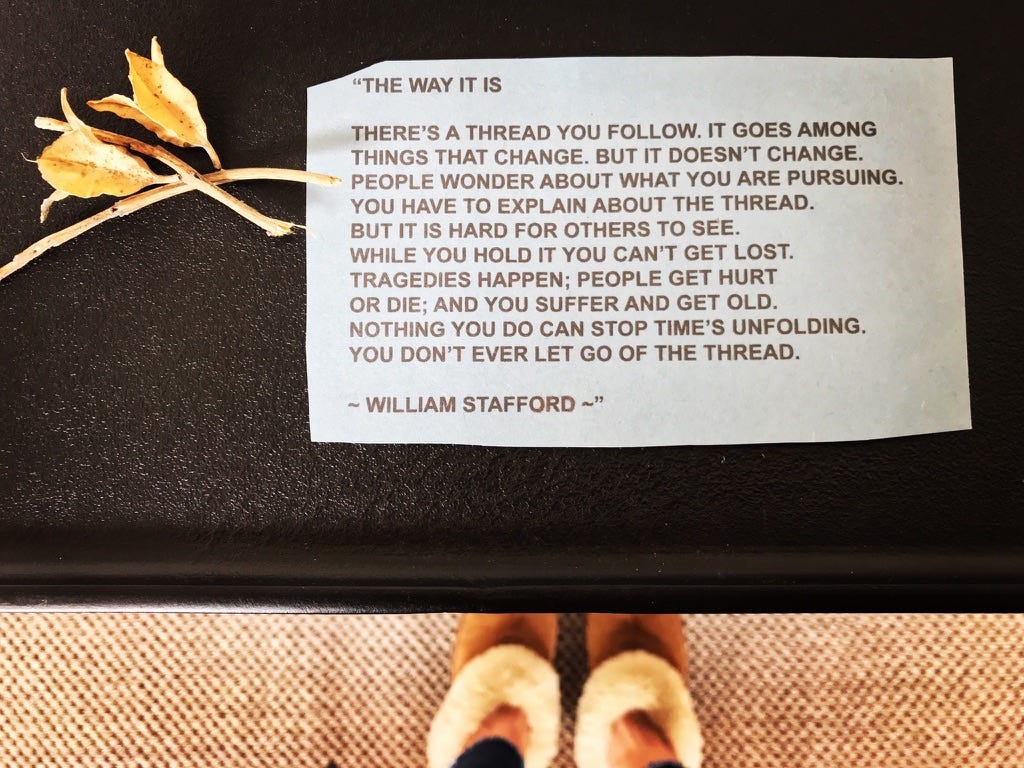
Each time I read this poem, I recall a different thread. Sometimes it is the thread of endurance, or inspiration. Sometimes the thread of loving-kindness. But I’ve noticed my thread vacillates more these days. Like many I speak with, it goes briefly missing, or fades. My thread luffs in the doldrums or flails in unruly winds. Too many things we love are crumbling before our eyes. The ties that keep us from coming unmoored no longer feel secure. It is getting easier to lose sight of the thread.
Often I wake up with anticipatory grief and its rueful companion, solastalgia. Sometimes, I wince with perhaps the sharpest of pain—the pain of watching precious lives fracture while refusing to close your heart.
The morning last, I needed to find a thread. I could sense my mammal body searching for one. It sought one thing that does not change, something stable and constant—predictable, if not fixed. Knowing the blunt truth that everything changes, still, I craved a merciful display of something that would change less rapidly.
Fortunately, a good friend helped me find the thread. In a dawn conversation, held in murmurs while others slept, she offered two threads so I might keep going. First, the thread of belonging somewhere, to someone. Second, the thread of purpose and direction. Our spiritual friendship, so direct and clear, gave me a sense of renewal. It inspired me to ask, so I might support you:
What is your thread today? What is one nourishing thing your mammal body can hold onto? When you find it, can you bring your heart’s energy to its constancy? Can you take it in?
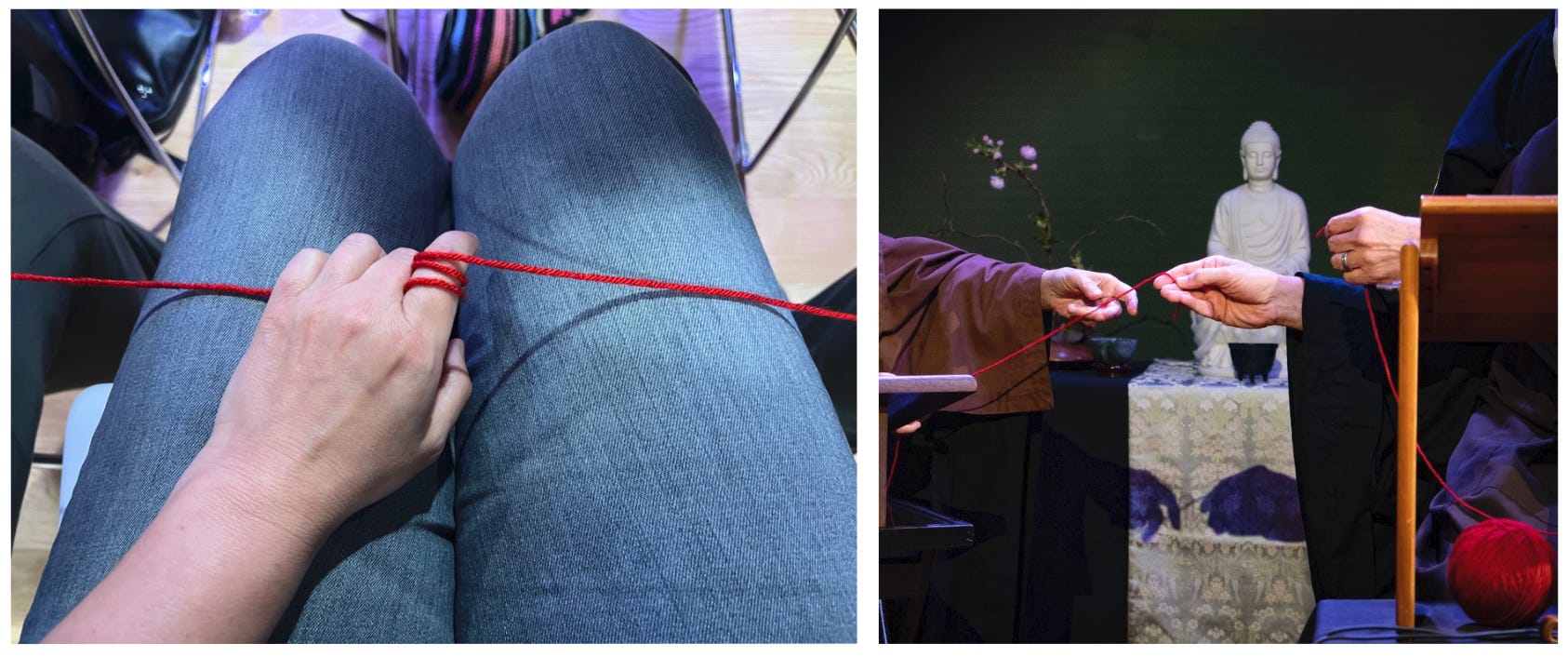
It strengthened me to rest my awareness on the threads a friend offered, to let them weave my soul back together, for now. I encourage you to find one thread that nourishes you today. Feel its fibers in your hand.
Crooked Cucumber: The Life and Zen Teaching of Shunryu Suzuki by David Chadwick.
‘Everything changes’ is also a recurring point of teaching in Shunryū Suzuki’s classic book Zen Mind, Beginner’s Mind. It’s an acknowledgement of one of Buddhism’s three marks of existence—śūnyatā—emptiness, voidness, insubstantiality, or the absence of an immutable essence.
Perfect for me too, in a knot of unusual busyness, feeling time pressure, reminding me to get in touch with my body, to feel and appreciate the aliveness that is especially apparent when stressed and see the natural ebb and flow of energy and feel the presence and calmness of my center. Beautifully done, Sunni.
An important post, Sun. You seem to somehow know the timing is right to remind fellow travelers of something important, something vital. In these times, specifically, it would be so easy to lose the thread. We all have, to some degree, had the black thread pull out of the needle’s eye and fall to the black carpet. So hard to see it. Just when you desperately need to stitch things back together. Your posts that come at interesting times can quickly remind us all that everything changes, and that there’s more thread on the spool so we might begin again. Thanks for that!